
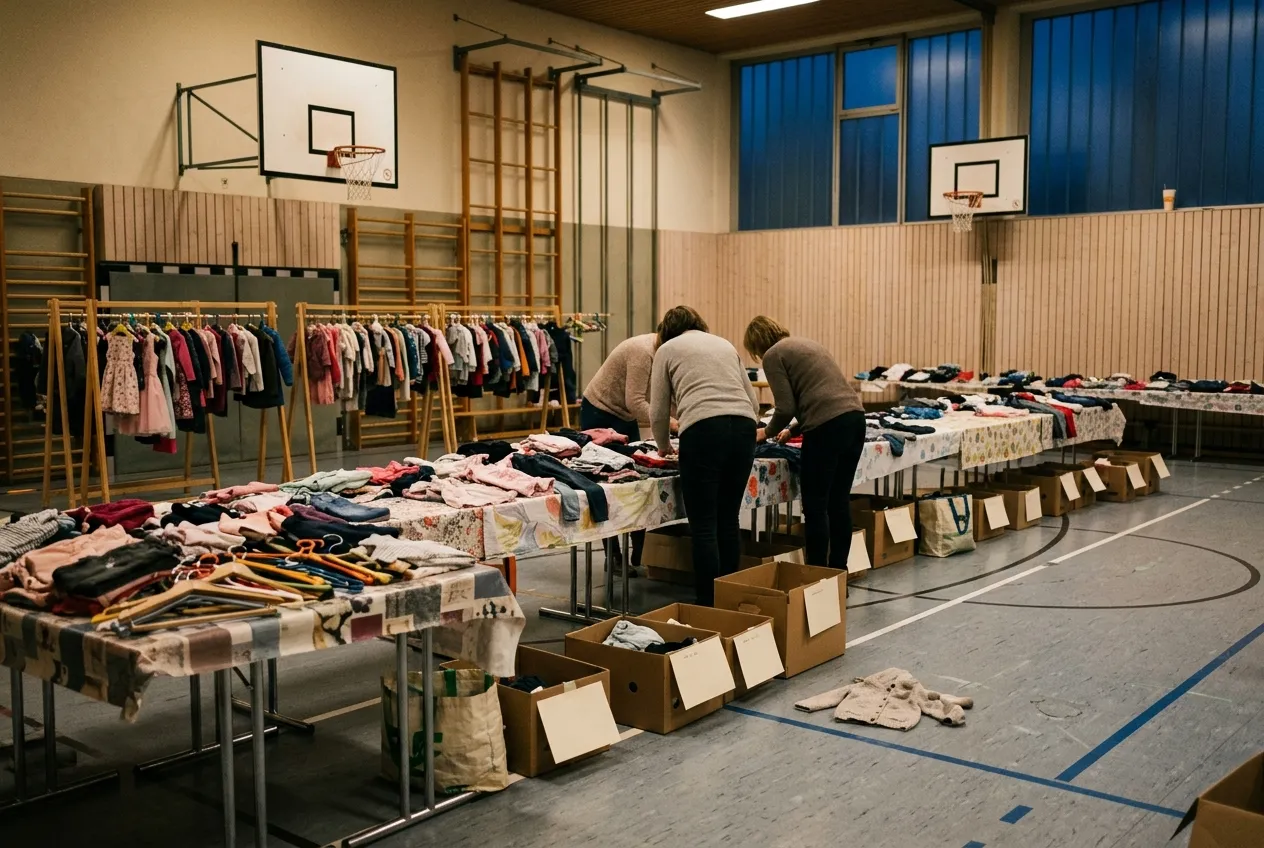
In short: The parents’ council of Fronberg primary school runs a pre-sorted children’s bazaar twice a year with 100 to 150 sellers and well over 400 paying visitors. The proceeds fund zoo trips, the healthy-snack programme and the St Nicholas and Easter baskets for the school – and this is the bazaar MukiBasar came out of.
This instalment of our series is a little different from the others. Because this time I’m not writing about a bazaar we got to know somewhere along the way – I’m writing about the one MukiBasar came out of in the first place.
The parents’ council of Fronberg primary school has been running its bazaar for many years. Twice a year, by season: once when the transitional jackets are needed, once when the sandals have to come back out. Between 100 and 150 sellers per event. Well over 400 paying visitors – and they rarely turn up alone, but with a child, a partner, a grandmother, or the neighbour who happened to be free.
This is not a side project. It is a major event that the parents’ council, the teachers, the school staff and a long list of volunteers pull off together. In Fronberg, people know when bazaar day is. The date is in the calendar before it is official.
”Good heavens, what was that”
There are two versions of how MukiBasar started, depending on who in the team you ask. Both of them are true. That is probably the most honest thing anyone can say about how it began.
Ramona tells it like this:
“The idea was actually put on the table by Yvonne, on the grounds that we needed something faster, without long queues at the tills, with straightforward labels – simply going online, the way you would today.”
— Ramona, parents’ council, Fronberg primary school
Yvonne sees it slightly differently:
“That’s not quite right. The idea came from Martin, after I came home completely wrecked from my first bazaar and said: good heavens, what was that 😂”
— Yvonne, parents’ council, Fronberg primary school
I can confirm that part. That evening I watched someone drop onto the sofa after twelve hours of sorting, taking money, carrying things and sorting again. And I started doing what developers do when they can’t help any other way: asking why. Why like this? Why does checkout take so long? Why does someone have to work out by hand, at the end of the day, who gets how much?
Everything that followed grew out of those questions.
The old system did its job well
This belongs in the story, and leaving it out would be unfair: Fronberg already had a system. No chaos of paper slips, no tally marks. A solution that ran for many years and made the team’s life considerably easier. Without it, bazaars of this size would not have been possible at all.
It just wasn’t at the level people expect from software today any more. No smartphone, no real time, no way for sellers to look anything up themselves. And – this is the point where it tips over – it was no longer being developed. A tool that stops moving doesn’t suddenly become bad. It slowly becomes hard work.
That is exactly where the Fronberg parents’ council stood: with a system they were right to be grateful for, and a growing sense that it couldn’t carry on like that forever.
Why the thing is called “Muki”
The question comes up a lot, and the answer has very little to do with marketing. Ramona puts it best:
“Why Muki? Because it turned us into a Muki family. A real friendship grew out of it. We deal in children’s clothes anyway – might as well do it legally 😂”
It sounds like a joke, but it is pretty much the truth. Over the years an organising team turned into a group of people who also meet up when there is no bazaar coming. The bazaar welded these people together – and the name simply carried that along.
What actually takes the work (and hardly anyone sees)
If you only experience the selling day, you see two or three hours of a busy gym. The work sits around it.
The organising beforehand. Handing out seller numbers, managing registrations, slotting in people from the waiting list, absorbing cancellations, filling helper shifts, keeping the cake list. That runs for weeks.
The setup. Carrying tables in from half the school building, putting up clothes rails, barriers, the till, the signage. A gym does not turn itself into a department store.
The sorting back. The part nobody expects the first time they help out – and the part that genuinely hurts. After the sale, every single unsold item has to go back to the person it belongs to. With 150 sellers and several thousand articles. In the evening, when everyone has been on their feet since morning.
The teardown. And afterwards the gym has to be a gym again. There’s PE on Monday.
It is exactly this block – organising, setup and teardown, sorting back – that explains why MukiBasar looks the way it does. The nice-looking sales view wasn’t the trigger. Sunday evening was.
What it is all for in the end
The proceeds stay with the school’s children. In practice that becomes things like:
- Trips to the zoo – for everyone, regardless of what money is like at home
- Kitchen equipment for the healthy break-time meal – from chopping boards to proper appliances, so that it can happen regularly at all
- St Nicholas and Easter baskets for every child
- The fancy-dress carnival breakfast – a healthy break-time meal, but in costume, and paid for entirely by the bazaar
None of this is a big acquisition with a brass plaque on it. These are the things that move a school day from “fine” to “that was lovely”. And they depend on enough people being willing, twice a year, to give up a weekend.
When other teams start asking
One thing should be said plainly here: MukiBasar was never meant to be a product. It was supposed to make the Fronberg bazaar easier, nothing more. No business plan, no target audience, no notion that anyone else would ever use it. It was simply a tool for a team I happen to know.
That it became more than that wasn’t down to us, but to people asking. Fronberg has become the address others call. How do you handle the numbers? How do you keep the queue at the till short? How does your settlement work? And at some point came the sentence that changed everything: “Could we have that too?”
The bazaar run by SC Kreith/Pittersberg is one of the examples where such a conversation turned into something of their own. It was those requests that turned an in-house tool into something you can hand to other people with a clear conscience. And that is exactly the direction this should go in: no bazaar should have to climb the same learning curve from scratch that another team has already been through.
Thank you
MukiBasar simply would not exist without the parents’ council of Fronberg primary school. Not as an idea, not as software, not in the form that runs in other school gyms today. Every feature we write about on this blog started out as a sentence someone from this team said after a long bazaar day.
To us, they are the heroes of the school gym. Even if they’d rather call themselves the Muki family. 💖