
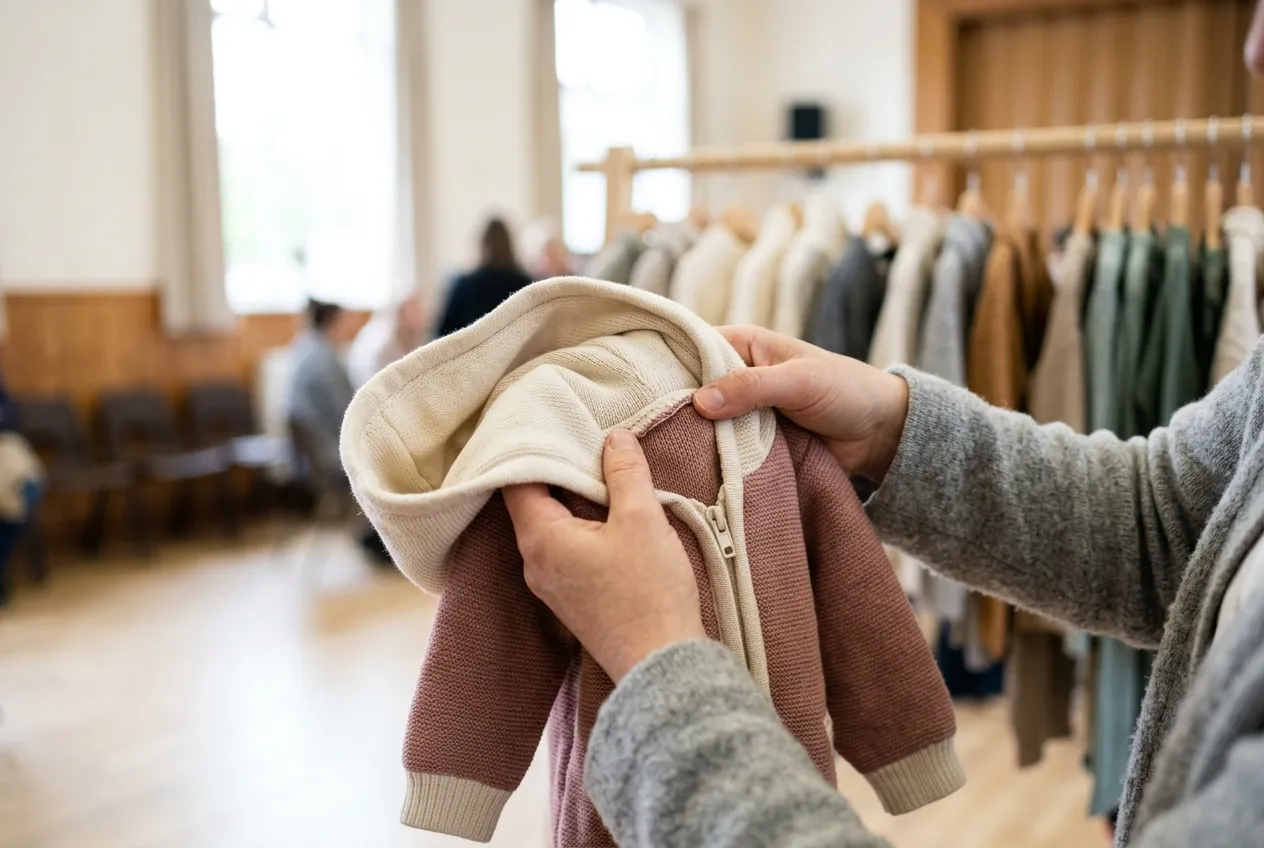
In short: Six moves, about two minutes in total: read the approval label and the year of manufacture, run your hand around the neck for drawstrings (standard EN 14682), measure the bar spacing on a cot (4.5 to 6.5 cm), look up brand and model in the EU recall portal Safety Gate, give everything a good shake – and buy bike helmets and car seats only where you can ask someone about their history. At a pre-sorted numbered bazaar that person isn’t there.
Saturday morning, just before nine, sports hall. You’re standing in front of a crate of bike helmets, holding one, and six people behind you are waiting for you to make up your mind. Eight euros instead of sixty. The helmet looks brand new.
And you don’t actually know what you’re supposed to be checking.
First, so it’s clear where this comes from: I don’t organize bazaars. I build the software they’re organized with, which means I spend a lot of time in halls where exactly this scene plays out. What struck me – and what none of the usual guides mention: at a pre-sorted numbered bazaar you’re missing something you take for granted at a flea market. More on that under point 5; that’s the actual point of this piece.
What follows is not a list of what you may and may not buy. That decision is yours, and part of the legal picture is genuinely disputed. It’s six moves – about two minutes in total – after which you’ll know where you stand.
1. The label first, the price second
For anything that’s more than fabric, the most important information isn’t on the price tag. It’s sewn in, stamped on, or stuck to the item.
Child car seat: the standard is printed on the orange approval label. Either ECE R 44/03 or 44/04 – the older generation – or UN R 129 (also known as i-Size), the current one. New R 44 seats have been barred from retail sale since September 2023, with remaining stock cleared by the end of August 2024. According to the ADAC (opens in a new tab), you may still keep using an R 44 seat you already own; no ban on use is planned.
Whether private resale of an R 44 seat is permitted is answered differently by different bodies. I’m not going to settle that here, and you don’t need me to: standing at the bazaar, that’s the second most important question. The most important one is under point 5.
Bike helmet: inside you’ll find the EN 1078 standard and, almost always, a manufacturing date. Remember that number – it matters shortly.
Toys: the CE mark and the address of the manufacturer or importer are mandatory. On second-hand items the packaging is long gone, so if it’s anywhere, it’s on the item itself. If both are missing entirely, you know nothing about where it came from – and for the youngest children’s toys, that’s an argument.
The label tells you the generation. The date tells you the age. Together they cost you five seconds.
2. Run your hand around the neck
This is the move that applies to the biggest pile in the hall – clothing is the bulk of every children’s bazaar – and it takes two seconds.
Since September 2006 the European standard DIN EN 14682 has applied: no cords or drawstrings in the neck and hood area of children’s clothing up to age 14. The standard followed a series of serious accidents, including two fatal ones in Berlin daycare centres in 2003, where children were strangled by a hood cord caught on a slide. Cords permitted elsewhere may protrude no more than 14 centimetres when the garment is opened at its widest, and cord stoppers have no business on the loose ends of functional drawstrings.
And here’s the part that applies specifically to second-hand: an item older than the standard can carry that cord perfectly legally. Those are exactly the things you find at a bazaar – well kept, a long time in the wardrobe, maybe already through two families. Condition tells you nothing here. The year of manufacture does.
So: take the hood in your hand, feel once around the neckline. If you find a cord, you can pull it out – or leave the item. Either is a deliberate decision, and that’s the whole point. More on this from the BZgA (opens in a new tab).
3. Bring a tape measure
Sounds excessive until the first time you’re standing in front of a cot.
Slat spacing: under DIN EN 716 it’s between 4.5 and 6.5 centimetres. Any less and a hand gets trapped; any more and a head fits through. You can measure that in five seconds, and it’s a number, not a judgement call.
Height: from the base in its lowest position to the top edge of the rails there must be at least 60 centimetres – so the child doesn’t fall out the first time it pulls itself upright.
Mattress: it has to fit the frame with no gap at the edge, and it must not be too soft. A child that can’t yet turn reliably can end up face-down in a sagging mattress.
And one point you can’t inspect your way out of: for a safe sleeping place, the BZgA advises against (opens in a new tab) cot bumpers, as well as pillows in the first year and loose blankets – a sleep sack instead of a blanket, and at most one small soft toy. Bumpers are still widely offered at bazaars, usually in immaculate condition. Condition isn’t the issue here.
4. A thirty-second recall check
You’ve got your phone in your hand anyway.
The EU rapid alert system Safety Gate (opens in a new tab) collects reports on dangerous non-food products across Europe; toys have been one of its largest categories for years. For Germany, the Federal Institute for Occupational Safety and Health (BAuA) additionally maintains its own database of dangerous products. Type in the brand and model, skim, done.
Why this is worth it for second-hand in particular: recalls reach retailers and the people who bought the product new. A playpen from 2019 recalled in 2021 will often pass through three more families without anyone ever hearing about it. Used goods are the blind spot of the system – and at that moment, you are the only check there is.
5. The one question nobody at a numbered bazaar can answer
Here’s the difference that made me write this in the first place.
At a classic table bazaar or flea market, the seller is standing behind her table. You hold up the helmet and ask: “Has anything ever happened with this?” And then you hear the answer – and read the face that comes with it.
At a pre-sorted numbered bazaar, that person isn’t there. She dropped her crate off on Friday evening and drove home. Whoever is behind the table is a volunteer from the organizing team who first laid eyes on this item twelve hours ago and, in all honesty, knows nothing about its history.
For most things that doesn’t matter at all. With a jacket, a puzzle, a pair of wellies, you can see the condition. What you see is the information.
For two product groups it’s precisely the other way round – there, visible condition is useless:
- Child car seats. A seat that has been in a crash can look flawless. The structure and foam core absorb energy by deforming; once deformed, they won’t do it a second time. None of that is visible from outside.
- Bike helmets. A single fall is enough to damage a helmet permanently, and often you can’t tell by looking. On top of that the material ages: children’s helmets should be replaced after roughly three years anyway, even without a single fall.
None of that amounts to a rule you must follow. It amounts to a fairly simple personal one: anything that is only as safe as its invisible history, I don’t buy where I can’t ask anyone about that history. Clothing, toys, books, shoes – gladly, without reservation. Helmets and car seats I’d rather buy where someone can look me in the eye.
And this is explicitly not a criticism of bazaar teams. It’s the price of the very quality that makes a numbered bazaar good: you hand in your crate and drive home instead of spending a day behind a table. If a particular item matters to you, ask the organizing team anyway – some will put you in touch with the seller.
6. Check that it’s all still there
The last move takes the longest and pays off mostly with toys.
Small parts: for children under three, nothing that can be swallowed may come loose – as a rule of thumb, roughly the size of a table tennis ball. So don’t just look: pull and shake briefly. Whatever comes off will end up in a mouth eventually.
Button cells: the battery compartment has to be secured so a child can’t open it, usually with a screw. If the screw is missing – and on second-hand items it’s missing surprisingly often – the item isn’t usable again until you’ve replaced it.
Magnets: toys with swallowable magnets carry a mandatory warning, because two magnets inside the body can attract each other through the bowel wall. On loose bricks out of a jumble box, that warning is naturally long gone.
Completeness: missing pieces are annoying in a puzzle and a safety matter in a high chair, a playpen or a bike seat. If you can’t find the instructions online and aren’t sure everything’s there, leave it. The German consumer advice centres have a good overview (opens in a new tab) on toys, including harmful substances.
For organizing teams: decide this before Friday evening
If you run a bazaar yourselves, point 5 turns around: because the seller isn’t there on the day, your goods drop-off is the only moment anyone looks at these items at all.
I’m not going to tell you what to accept – that’s your call, and it depends on your hall, your team and your visitors. But the call should be made before the queue forms at six on Friday. The typical failure isn’t the wrong rule, it’s no rule: two volunteers at the same table give the same seller two different answers, and both feel bad about it.
Five questions to settle in the team beforehand:
- Do we accept car seats, bike helmets and cots at all? Yes or no – not case by case at the desk.
- If yes: do we check anything, and against what exactly? Label, year, completeness? Whatever isn’t on the list doesn’t get checked.
- Who decides in case of doubt? One named person per shift. Three opinions are not a rule.
- What happens to a rejected item? Back in the crate, or not accepted in the first place – and who tells the seller?
- Where is this written down, before someone drives two hours? In the event description, alongside the rest of your rules.
The last point matters most and costs least. We already advise sellers to read their bazaar’s rules before registering – which only works if there’s something there to read.
And now don’t overthink it
The overwhelming majority of what’s lying in that hall is clothing. Clothing is the category where buying second-hand is a good idea without any qualification whatsoever: for your wallet, for the wardrobe, and for the sheer volume of stuff being produced. Children outgrow trousers faster than trousers wear out – which is precisely why those trousers are there.
The six moves cost you about two minutes together, and by your third bazaar you’ll do them without thinking. Label, neck, tape measure, phone, the one question, and a good shake.
| Move | What to look for | Time |
|---|---|---|
| Read the label | Standard (ECE R 44 / UN R 129, EN 1078, CE mark) and year of manufacture | 5 seconds |
| Feel the neck | No drawstrings in the neck and hood area (EN 14682) | 2 seconds |
| Tape measure | Bar spacing 4.5–6.5 cm, side height at least 60 cm | 5 seconds |
| Recall check | Search brand and model in Safety Gate | 30 seconds |
| The one question | Helmet and car seat: who knows their history? | – |
| Shake it | Small parts, battery-compartment screw, magnets, completeness | the longest |
You’ll find the next date near you in our bazaar listing.
Frequently asked questions
Can I buy a second-hand car seat approved under ECE R 44?
You may keep using an existing R 44 seat according to the ADAC; whether private resale is allowed is answered differently by different sources. More important is the question nobody at a numbered bazaar can answer: whether the seat has ever been in an accident. You can’t tell from the outside.
How old can a second-hand bike helmet be?
Children’s helmets should be replaced after roughly three years, even without a fall – the manufacturing date is printed inside next to the EN 1078 standard. A single fall can damage a helmet invisibly; so buy it where you can ask about its history.
How do I know whether children’s clothing is allowed to have drawstrings?
Since September 2006, EN 14682 rules out cords and drawstrings in the neck and hood area of children’s clothing up to age 14. Older items can legally still have them – pull the cord out or leave the item.